

TLDR: Value creation is not a one-size-fits all approach, especially to low-mid market firms. Applying AI-led operational changes can galvanise management, and spur wider change in organisations, whilst avoiding the pitfalls experienced by current mid-market PE practitioners.
The Private Equity (PE) industry is transfixed on "value creation" as driving future returns and eventual DPI. However, the methods used by large PE firms typically fail when applied to the low-mid market. How can an active, AI-led approach change this dynamic?

McKinsey highlighted that prioritising value creation increased returns on exit by two-three percentage points (1). Yet eighty percent of firms using generative AI saw no improvement in revenues or profitability (2). With AI adoption and technology at the vanguard of driving productivity improvement, why do we see such a contradiction? And why does this affect SMEs, who are only fifty percent as productive as large firms, and in Asian economies like India and Indonesia, only twenty-five percent so (3)?
If these statements held true in APAC, low-mid market funds should be generating superior performance vs their large-cap peers as they bridge this productivity gap. That isn't the case. This leads us to question what does value creation actually mean?
A lot of this is shaped by Tier 1 firms, from which such practices filter down to low-mid market players. For these players, this is also shaped by giving LPs comfort that their approach is "best-in-class". So what does value creation mean to large-cap firms, and how do they deliver upon this?
How large-cap Private equity deliver value creation
With our background in Tier 1 private equity, we can assert a value creation team isn't there to deliver value. It is instead there to establish yardsticks and processes that both monitor and hold relevant stakeholders to account. Even with well-staffed teams, each member is spread too thinly across several portfolio companies to devote substantive time to genuinely drive performance.
This results in a flurry of activity within the first 100 days, building on prior commercial due diligence work. This takes the form of "toolkits" being applied, that serve as audits into areas that may include pricing, marketing, procurement, working capital and treasury, tax and accounting, cybersecurity, digital readiness, and critically, HR organisational design. Once concluded, barring any ad-hoc initiatives that are outsourced to third-party consultants, results in business plans and yardsticks being established, with the CEO, CFO, and Chairperson held to regular, periodic account. This is broadly what endures until eventual exit.
This is fine. A firm generating US$50m+ in EBITDA will already have established internal controls, systems, and HR capacity to absorb any learnings and then deliver. But it renders your value creation team effectively as a series of HR Business Partners, with some functional knowledge, which lags leading practices (though this is mitigated by shared knowledge accrued across a portfolio of companies, use of advisors, and vendors). This suits all parties: senior management wants to manage without interference, and deep-down, PE operating partners do not want to be held accountable for underlying performance of the companies they oversee.
Don't take that from us - this is how McKinsey measured the value creation uplift mentioned above (1):
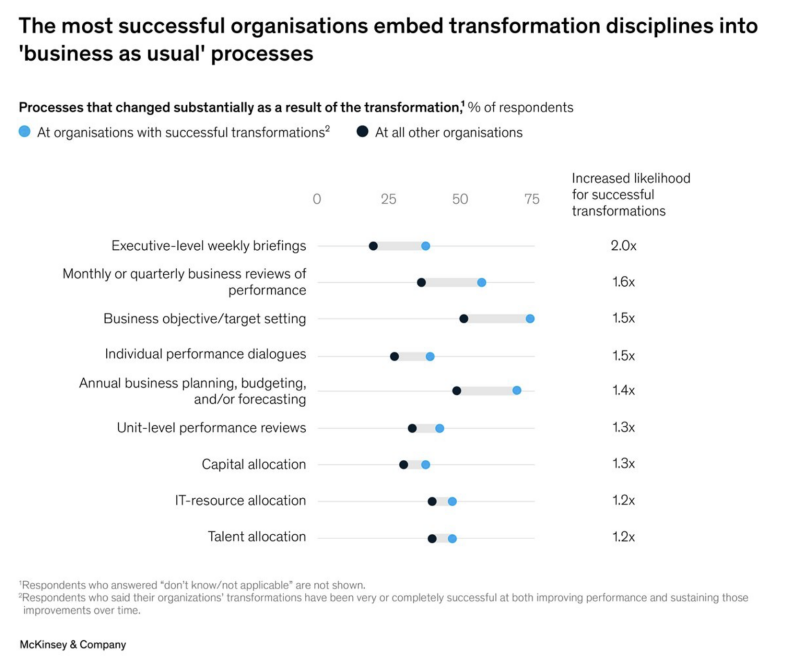
However, contrary to the graph above, the reality of a lot of large-cap "value creation" really results from:
- Rising revenue growth - benefiting from existing demand, whilst consistently raising price levels throughout ownership
- Acquiring SMEs cheaply (e.g. 4x) to revalue at the company's valuation (12x-15x). These typically are in the same service line vs entering new markets or adjacencies, further benefiting from cost-synergies
- Some financial structuring, through both debt and tax-based arbitrages, though their impact continues to diminish
- (Even now) Hoping that asset inflation passes through into higher valuations for the same underlying asset
This may seem cynical. However the difficulty and portfolio resistance to these measures are low - they deliver a "sugar-rush" effect on portfolio returns with minimal effort - delivering "quick-wins" in the parlance of PE executives. For genuine performance enhancement (e.g. that could overcome the productivity deficits mentioned above) requires more substantive change management over time - which does not come naturally to the PE industry at large.
Why these value creation practices don't work in the low-mid market in Asia
Low-mid-market firms lack personnel - with value creation left to deal teams to deliver - and are spread even more thinly than their large cap peers. Though replicating the above, there is a greater dependency on third-party agencies to work with management to deliver improvement, whilst maintaining monitoring and accountability oversight. Surely that's fine? After all, McKinsey state that having weekly briefings and monthly or quarterly business reviews can increase successful transformations by 2.0x and 1.6x respectively?
However, the foundations that large-cap investments rely upon are at best rudimentary, if not non-existent, at low-mid market level. To provide examples:
- Key-person risk: With succession plans lacking, what happens if a company loses staff that handle key customer, supplier, and/or regulatory relationships?
- Leadership culture: A lot of low-mid market firms are family-owned in Asia, and rely on the personal idiosyncrasies of owners, which may not accord with arms-length industry standards. What happens if you introduce changes that go against their "way" of doing things?
- Patronage vs sponsorship of personnel: With firing practices quite restrictive across most of Asia, how do you handle personnel employed by virtue of their relationship with owners rather than on merit? How does that affect your ability to professionalise functions like Finance or Marketing?
- Audit vs Internal controls: We have encountered a lot of companies that take pride in having audited financials undertaken - and it is of help to know cash balances reconcile to management accounts. But who determines where these sums are spent, and are they spent in the best interests of the company?
This list can go on. Most mid-market firms respond by relying on either price increases or M&A, as anything else involves fundamental, structural change - of which most low-mid market firms are simply ill-suited to manage, especially given the inevitable conflict that change management generates.
How does AI-led transformation change this dynamic?
As a data scientist that has led corporate change, and endured the full spectrum of change management outcomes, developments in generative AI / multi-agentic workflows have fundamentally changed this dynamic. Where this has been of benefit to Matsu Partners has been:
- To identify value and build the case for change early: Prior to deal agreement, how owners and their management team respond to such findings highly correlate with their willingness to embrace and drive change. A guarded or lukewarm reception = don't invest
- Capture knowledge and assemble toolkits: These are no longer the preserve of the large-cap funds. AI Agents, when orchestrated correctly, enable a wealth of different information sources to be assimilated. When combined with a company's data, it becomes feasible to replicate the same "Tookits" used by large-cap PE without the associated headcount. Pricing and marketing are two areas where our tools have made a difference.
- Offering continuous vs discrete improvement: The toolkits above are inherently discrete - they provide a point-in-time assessment. Yet all these elements above evolve continually. For instance, pricing elasticities looked very different for us before / after the Iran conflict in February 2026. These tools enable insights to be continually updated, guiding an informed response.
- Getting into the weeds faster: We were able to apply these tools within days to undertake an internal audit of one company, which otherwise would have taken weeks. This enabled us to discuss and prioritise action with management faster, to the benefit of stakeholders.
- Assessing HR and operational resilience: These AI capabilities not just enable speed of analysis - they help assess underlying talent within an organisation (i.e. how they engage with AI), where upskilling or other support can be targeted. They can also identify behaviours that need to be challenged as well.
What surprises most people is this doesn't need to rely upon an existing CRM, ERP, or HRMS system to deliver these insights. Combined with our active approach, where we partner with management, we believe this provides a suitable balance where their expertise can be empowered, but crucially supported by institutionally recognisable structures that can guide this energy constructively.
Conclusion: Will we see value creation practices evolve?
The question is more "when" rather than "if". Most low-mid market firms, as with SMEs, are aware and certainly have sought to experiment in different guises - whether directly through building dedicated AI workflows, or using AI functionality incorporated into a vendor's offering.
How quickly this occurs will depend ironically on the sophistication of LPs. Though there is much benchmarking on returns, and interviews with relevant personnel, LPs are still lacking in tools to evaluate what measures are actually being undertaken, and how these compare to other funds. By example - how will your approach to marketing lower acquisition costs vs a rival PE fund? Until LPs develop their confidence in this area, the onus will remain with GPs to translate such initiatives into results - which given the alternatives around M&A, etc, that deliver "sugar-rush" outcomes, may not be a priority despite public statements on AI adoption to the contrary.
As a final reflection, and to highlight this gulf that exists, we had a call with one well-known DFI where they were looking for a system of measurement described above. They shared an anecdote which prompted their outreach. They asked the Partner of a fund how they were incorporating AI into their processes, to which the Partner responded (to paraphrase): "We upload the data of targets and our portfolio companies into AI, and we turn this into Podcasts, which we listen to in the car or at the gym to speed-up our understanding". Be assured - AI can deliver so much more!
- "Value creation: the impact counts, not the plan", McKinsey, 24th Oct 2025
- "Beyond the Hype: Unlocking Value from the AI Revolution", McKinsey, 8th Sep 2025
- "Why closing the small business productivity gap can create enormous value for economies", McKinsey, 17th Jun 2025